Do Permanent Christmas Lights Need an Electrician in Washington?
Sometimes. Washington decides it by the kind of lighting product, not by how many volts run through it, and the answer for your house usually turns on one plain question about how the system is built.
Every source on this page was read on .
Do permanent Christmas lights need an electrician in Washington?
The short answer is that it depends on the product, and Washington says so in writing. The Department of Labor & Industries (L&I) put it this way in its December 2025 Electrical Currents newsletter: "Licensing and certification requirements depend on the type of lighting products used, not the installation voltage."
L&I then splits holiday and year-round lighting into two kinds.
- Field-fabricated lighting, meaning custom systems cut to fit and put together at the house, has to be installed by a licensed electrical contractor that employs certified electricians, and L&I adds that "these installations also require permits and inspections."
- Factory-assembled lighting, meaning unaltered off-the-shelf products built to UL 588 (the standard for seasonal and holiday decorative products), does not need a licensed electrical contractor or certified electricians to put it up.
So a permanent roofline system can land on either side. Two systems that look the same from the street at night can sit under different rules because of how they were made and what was done to them on the ladder. The permanent christmas lights page shows that line as two cards side by side; this page is about the rules behind it and what they mean for a homeowner in Clark County, WA.
Why "it's low voltage" does not settle it
Many permanent systems run the lights themselves at low voltage from a power supply near the outlet, and that leads a lot of people to assume no electrical rule applies. L&I's newsletter answers that directly: the voltage is not what decides it.
The written exemption people sometimes point to is narrow. WAC 296-46B-925(8) frees a short list of low-voltage circuits from licensing and permitting: garage doors and built-in vacuums in a house, and, underground, landscape sprinklers, landscape lighting and the antennas for an invisible pet fence. Even those qualify only when they run from a listed Class 2 power supply, and the line-voltage side feeding them is still work for licensed people. A run of lights fastened along an eave is on none of those lists, and the words holiday, seasonal and christmas do not appear anywhere in that rule. If an installer tells you a system is exempt because it is low voltage, ask which rule they mean and read it with them.
Do you need to be an electrician to install Christmas lights?
For the ordinary seasonal job, no. Strands of C9 or mini lights bought as finished products, clipped to the gutter and plugged into an existing outlet, are the factory-assembled side of L&I's line. A separate rule points the same way: WAC 296-46B-925(10) leaves firms that install listed plug-and-cord equipment outside the licensing chapter, as long as the product is a single manufactured unit that needs no wiring assembled on site beyond the plug and cord. Washington's electrical licence is not what governs that work.
A different law can still apply. Washington's contractor registration law, RCW 18.27, covers anyone who in the pursuit of an independent business works on an improvement attached to real estate, and L&I's December 2025 note says that "if fasteners are used to attach lights to a structure, contractor registration rules under RCW 18.27 may apply." It says may. The statute has a small-job exemption for work under $500, and RCW 18.27.090(9) says that exemption does not apply to anyone who advertises as a contractor. Neither the RCW nor the newsletter says which holiday lighting jobs count, so this page does not either. L&I's contractor registration office is the place to ask.
Can I install my own permanent Christmas lights?
Washington treats an owner working on their own property differently from a hired installer. RCW 19.28.261(1) says nothing in the licensing sections requires a licence for electrical work at a person's own residence, farm, place of business or other property they own, with two exceptions written into the statute: a new building meant for rent, sale or lease, and property offered for sale within 12 months of getting it. The permit is a separate question. L&I's permit basics say that whoever performs the electrical work is responsible for getting the permit before starting, and that you cannot use a permit someone else bought. Its property owner permit form has the owner sign an affidavit claiming the exemption before the work begins. The exemption is personal. It does not stretch to a friend, a handyman or a company you pay.
A kit sold for homeowners can be the easy half of this. If it is a finished, listed product that goes up as sold and plugs into an outlet that already exists, you are on the factory-assembled side. If you start cutting the track and splicing runs together, or adding an outlet to feed it, you have moved into the work L&I ties to a permit, owner or not.
| Source | What it says |
|---|---|
| L&I, Electrical Currents, December 2025, page 2 | The rule turns on the product type, not the voltage; field-fabricated systems need a licensed electrical contractor, certified electricians, a permit and inspections; unaltered UL 588 products do not need the contractor or electricians; fasteners may bring in RCW 18.27 |
| RCW 19.28.041 | an electrical contractor's licence is required to do electrical work for others |
| RCW 19.28.161 | the people doing the electrical work hold a certificate of competency |
| RCW 19.28.261 | subsection (1): no licence is required for work on property the person owns, except a new building for rent, sale or lease, or property offered for sale within 12 months |
| L&I, Electrical Permit Basics | whoever performs the work gets the permit before starting; nobody may use a permit someone else bought |
| WAC 296-46B-925 | subsection (8): the low-voltage exemption lists garage doors, built-in vacuums and underground landscape circuits, on a listed Class 2 supply; subsection (10): firms installing listed plug-and-cord equipment are outside the licensing chapter |
| WAC 296-46B-901 | subsection (7): a permit is required for installing electrical systems or equipment; the only outlet exception is like-for-like replacement of up to five |
| RCW 18.27.090 | subsection (9): the under-$500 registration exemption does not cover anyone who advertises as a contractor |
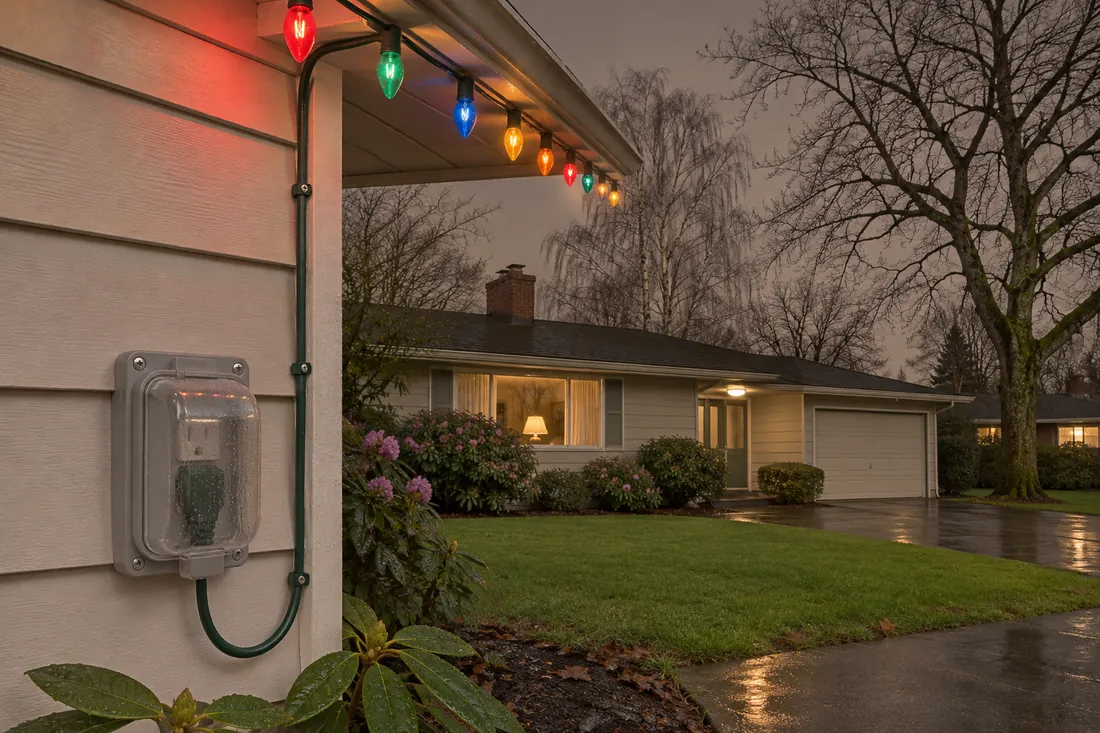
The outlet is often the real electrical job
On a lot of Clark County, WA houses the lights are not the hard part. The power is. A permanent controller wants an outdoor outlet close to where the track starts, usually on the garage wall or under the eave at one corner. If the only outdoor outlet on the house is by the front door, somebody has to bring power to the right spot.
Adding an outlet, moving one or running a new circuit to the eave is electrical work in its own right, whatever is plugged into it later. L&I's owner permit form opens by saying that in Washington only licensed electrical contractors employing certified electricians may perform electrical work, the owner exemption aside. And WAC 296-46B-901(7) requires an electrical work permit for installing electrical systems or equipment, with a list of exceptions whose only outlet item is replacing up to five existing receptacles like for like. A new outlet is not on that list. So when you get a quote, look for a separate line for the power: who adds the outlet, whether a permit is pulled for it, and whether the price includes the inspection. When two quotes look far apart, this line is often where the gap is, and the cheaper one is not always the one that includes it.
Who issues the electrical permit at your address in Clark County, WA
When a permit is needed, it comes from one of two places in this county. L&I keeps a list of the cities that run their own electrical permits and inspections, and says that if a job is not inside one of those cities, the permit comes from L&I. Vancouver, WA is the only Clark County city on that list. Each of the smaller cities' own sites says the same thing in its own words.
| Where the house is | Who issues the electrical permit | Where that is written |
|---|---|---|
| Inside the city limits of Vancouver, WA | The City of Vancouver, WA, which also inspects | L&I's list of cities that issue their own permits |
| Unincorporated Clark County, WA: Hazel Dell, Salmon Creek, Felida, Orchards, Brush Prairie and the rural roads | L&I | the same L&I page: outside the listed cities, the permit comes from L&I |
| Camas | L&I | City of Camas building questions |
| Battle Ground | L&I | City of Battle Ground FAQ |
| Ridgefield | L&I | City of Ridgefield home improvement page |
| La Center | L&I | City of La Center building page |
| Washougal | not on L&I's list of self-permitting cities; the city's own current pages do not say | ask the City of Washougal building office before the work is booked |
Hazel Dell and Salmon Creek trip people up. Houses there often carry Vancouver, WA mailing addresses but sit outside the city limits, so an L&I permit is the usual answer there, not a city one. Check the house against the city limits rather than the envelope.
The paper trail worth keeping
Most of the advice about permanent lights stops at "hire someone qualified." That is hard to act on from your kitchen table, so here is what to ask for and keep instead. None of it takes long, and all of it is useful the first time a gutter is replaced or the house is sold.
- A sentence in the quote saying which kind of system it is: factory-assembled and used as sold, or cut and assembled on site. An installer who knows will not mind writing it down.
- The product's listing. Ask which safety standard the product is listed to (L&I's note names UL 588 for seasonal decorative products), ask for the model name, and keep a photo of the listing label.
- The Verify result. Look the firm up on L&I's Verify tool, which shows contractor registration, bond and insurance and any electrical licence. Save or print the result the day you sign, because status changes.
- The permit number and the final inspection. If a permit applies, ask for the number before work starts and the inspection result when it is done. You can look it up yourself with whichever office issued it.
- A sketch of where the power is: which outlet or circuit feeds the controller, where the power supply hangs, and where the wire runs down the wall. Whoever reroofs or repaints next will want it.
What this site does, and what it doesn't
Clark County Holiday Lighting is a free place to ask for a quote. It owns no lights and wires nothing, and it makes no statement about the licence or registration of any installer. The request goes to one local installer, who prices the job, and the checking above is yours to do. If you want the seasonal kind that comes down in January, the christmas light installation in Vancouver, WA page covers it.
Other questions about permanent lights and the rules
How much does it cost to have someone install permanent Christmas lights?
Published guides price it by the foot of roofline installed, and the permanent christmas lights cost page sets out each publisher's figure and the date it was read. If the job needs a new outdoor outlet or circuit, or a permit, ask whether those are inside the quote or added later.
Do Christmas lights run up the electric bill?
That is arithmetic you can do from the label. Find the wattage of the whole run, multiply by the hours a night it is on and the nights in the month, divide by 1,000 for kilowatt-hours, and multiply by the rate on your utility bill. LED points draw less than the old incandescent C9 bulbs, so most of a permanent system's cost is the installation, not the power.
Does a plug-in system still need a permit?
Plugging a finished, listed product into an existing outlet is not the work L&I's note ties to a permit. Adding or moving the outlet is a different matter, and so is a system cut and assembled on site. When it is not clear which of those your job is, ask the permit office for your address before the work starts.
Who should I hire to install permanent Christmas lights in Washington?
Someone who can tell you, in writing, which kind of system they are putting up and who pulls the permit if one is needed, and whose name checks out on L&I's Verify tool before you sign. A quote request sent from the permanent christmas lights page goes to one installer in Clark County, WA, who prices the job first, and you decide from there.